In brief
After a conditional job offer, the employer can set conditions such as a background check, medical exam or references, and each has its own notice rules before the first day. In California the employer must also hand over a written pay notice no later than the first day of work.
- Employment with no specified term “may be terminated at the will of either party on notice to the other” in California, and “employment for a specified term” means a period greater than one month2.
- Before ordering a background report, a federal employer must give a written disclosure “in a document that consists solely of the disclosure” and get written authorization3.
- Before acting on the report, the employer must give the person a copy of it and a written description of their rights under the Fair Credit Reporting Act3.
- Most California employers with five or more employees cannot ask about conviction history, or run a criminal background check, before a conditional offer4.
- California’s written pay notice is due “in no event later than the first day services are performed by the employee”1.
This page explains how the paperwork and process work. It is not legal, tax or HR advice, and this site is not a law firm.
The detail
An offer is the first of several steps, each with its own rule. This page follows them in order and links to the page that goes deep on each: offer letter vs employment contract, contingent job offers, rescinded offers, what shows up on a background check, references, and the first-day paperwork.
Federal rules are the baseline; California is the one state worked through in detail, because its rules add steps.
The short answer
| If you are… | Start with |
|---|---|
| Holding an offer, or one that lists conditions | Step 1 and Step 2 |
| Told a background check is coming | Step 3, then what shows up on a check |
| Received a notice that a report may cost you the job | pre-adverse action notice and disputing an error |
| Worried a past employer will say something | Step 4, then what a former employer can say |
| Asked about pay, age or criminal history | Step 5 |
| Told the offer was withdrawn | Can an employer rescind a job offer? |
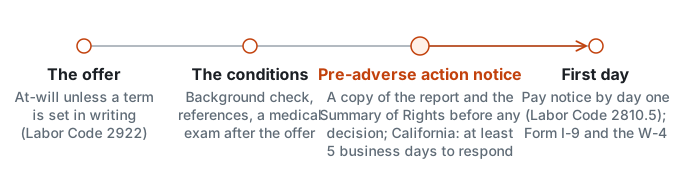
Step 1: The offer, and what it binds
An offer is the employer saying it will hire you on stated terms. What it binds depends on whether the employment has a specified term.
In California the default is at-will employment. Labor Code section 2922 says employment “having no specified term, may be terminated at the will of either party on notice to the other,” and that “employment for a specified term means an employment for a period greater than one month”2. At-will means either side can end the job without having to give a reason, on notice. It does not remove the limits on firing for a protected reason; the Department of Labor’s termination page says that outside protected grounds, a termination “is subject only to any private contract between the employer and employee or a labor contract,” and lists age, race, color, religion, sex, ethnic or national origin, disability, veteran status and whistleblower status among the protected grounds5.
So an offer that sets a fixed term is a different thing from an offer that sets none. Under Labor Code sections 2924 and 2925, an employment for a specified term may be ended by the employer for a willful breach of duty, habitual neglect or continued incapacity, and by the employee if the employer willfully or permanently fails to meet its obligations67. Whether a given letter creates a term is a question about its words, which is the subject of offer letter vs employment contract.
Good to know The California pay notice in Step 6 is a separate document with its own required contents. An offer letter that states a salary does not take the place of it1.
Step 2: The conditions
A conditional (or contingent) offer depends on the candidate meeting requirements before starting work. No agency page defines the term or lists the conditions an employer may use, so the useful way to read a list of conditions is by the rules that govern each one:
| A condition an offer may name | The rule that governs it |
|---|---|
| Background check | The Fair Credit Reporting Act: disclosure, written authorization, notice before and after any adverse decision38 |
| Criminal history | California’s Fair Chance Act: no criminal-history inquiry or check before a conditional offer, then a set of steps before the offer is withdrawn4 |
| Credit report | California Civil Code section 1785.20.5: the employer must tell the person when employment is denied in whole or in part because of a credit report, and give the agency’s name and address9 |
| Medical examination or disability-related questions | The Americans with Disabilities Act: allowed only after a conditional offer, and only if applied to all entering employees in the same job category10 |
| References | No statute requires or bars them; see Step 4 |
If an offer is withdrawn based on medical information, the EEOC says the employer must show the reason was job-related and consistent with business necessity10. More on how conditions work, and what can void an offer, is on the contingent job offer page.
Step 3: The background check and its notices
The federal steps
When an employer hires a company to produce a background report, the report is a “consumer report” and the Fair Credit Reporting Act applies. The statute, 15 U.S.C. 1681b(b), says the employer cannot get the report unless two things happen first: “a clear and conspicuous disclosure has been made in writing to the consumer at any time before the report is procured,” in “a document that consists solely of the disclosure,” and the person “has authorized in writing” the report3.
The Federal Trade Commission’s consumer page breaks the process into four steps8:
- Disclosure and authorization. The employer tells you in writing, in a standalone document, that it could use a report to decide on hiring, and gets your written permission before the check is run. You can refuse, but the FTC notes you may not get the job.
- Pre-adverse action. Before rejecting you based on the report, the employer gives you a copy of it and a “Summary of Rights.”
- Adverse action notice. After the decision, the employer tells you, “verbally, in writing, or electronically,” the reporting company’s name, address and phone number, and that the company did not make the decision.
- Free copy and dispute. You can ask the reporting company for an additional free report “within 60 days of the employer’s decision,” and dispute inaccurate or incomplete information directly with it.
The statute’s wording for step 2 is that “before taking any adverse action based in whole or in part on the report,” the employer “shall provide to the consumer” a copy of the report and a written description of the person’s rights3. Neither the FTC’s business guidance nor the EEOC’s page sets a waiting period between that notice and the decision; the FTC says only that advance notice gives the person “the opportunity to review the report and tell you if it is correct”1112. The EEOC adds that the disclosure “can’t be in an employment application”12.
What California adds for criminal history
California’s Fair Chance Act applies to public employers and to private employers with five or more employees, and covers applicants as well as employees who are promoted or otherwise undergoing a check4. Under the Civil Rights Department’s fact sheet (June 2025), most covered employers cannot ask about conviction history on an application, cannot run a background check or internet search for criminal history before a conditional offer, and cannot post statements such as “No Felons”4.
After a conditional offer, the employer may look, but certain information stays off limits: arrests that did not result in conviction (with limited exceptions), sealed, dismissed or expunged convictions, diversion cases, and, per the fact sheet, “conviction history that is more than seven years old” measured from disposition, release or parole4.
If the employer wants to withdraw the offer over a conviction, it must send a written preliminary notice listing the convictions, enclosing the report, stating the right to respond, and giving a response deadline. After considering any response, it sends a final written notice that includes the right to file a complaint with the Civil Rights Department4. The full sequence is on the Fair Chance Act page.
Sources disagree The response window when the person disputes the report’s accuracy is worded two ways. The Civil Rights Department’s fact sheet says “at least five business days” and “at least ten days” if the person is challenging accuracy, without saying “business” for the ten4. The statute, as reproduced on a mirror of Government Code section 12952, gives five business days plus “five additional business days” for a written dispute13. Ten business days is the longer of the two readings, so it is the one to plan around.
For the notice itself and the response, see the pre-adverse action notice page; for correcting a wrong report, disputing a background check error.
Step 4: References
The Society for Human Resource Management, a professional association, says “there are no federal laws that address what an employer can or can’t say about a worker”14; no agency page states this either way. In California the rules sit in a handful of Civil and Labor Code sections.
Civil Code section 47(c) gives a qualified privilege to a statement about an applicant’s job performance or qualifications when it is “based on credible evidence and made without malice by a current or former employer,” made to a prospective employer on that employer’s request15. Labor Code section 1050 makes it a misdemeanor to prevent or attempt to prevent a former employee from getting work “by any misrepresentation,” and section 1054 gives the person harmed a civil action for treble damages1617. Section 1053 allows a truthful statement about why an employee was discharged or left, “when specially requested”18.
Whether a former employer can say you were fired is therefore a matter of truth, request and malice, not of a single rule. It is covered in what a former employer can say about you, including the three states, Missouri, Minnesota and Maine, where an employee can request the reason for discharge in writing.
Step 5: The questions an employer may and may not ask
Some questions are limited by rule at any stage. The ones the sources address:
| Subject | What the rule says |
|---|---|
| Age | In California, employers generally cannot ask a candidate for “their age, date of birth, or graduation date” on an application, in an interview, or by email or text. Employers with legal reporting requirements may ask in ways that reveal age “for record-keeping purposes only”19. |
| Salary history | Under Labor Code section 432.3, an employer may not rely on salary history in deciding whether to hire or what to offer, and may not “orally or in writing, personally or through an agent, seek salary history information.” Applicants may volunteer it, and employers may ask about salary expectations20. |
| Pay scale | On reasonable request, an employer gives the applicant the pay scale. An employer with 15 or more employees includes the scale in any job posting2021. |
| Conviction history | Not before a conditional offer, for most California employers with five or more employees4. |
| Medical questions | Only after a conditional offer, applied to everyone entering the same job category10. |
The pay scale is “a good faith estimate of the salary or hourly wage range that the employer reasonably expects to pay for the position upon hire,” and the Labor Commissioner’s Office says a link or QR code to a separate scale does not satisfy the posting rule2021. The complete picture, including the recruiter question, is on salary history and pay scale in California.
Step 6: The pay notice at hire
California Labor Code section 2810.5 requires a written notice at hire. The Labor Commissioner’s Office says all private sector employers are covered unless a listed exception applies; the exceptions include employees exempt from overtime and certain employees under a qualifying collective bargaining agreement1.
The notice is due at the time of hiring and “in no event later than the first day services are performed by the employee,” in the language the employer normally uses to communicate employment information1. The notice covers the rate or rates of pay and their basis, including overtime rates; any meal or lodging allowances claimed against minimum wage; the regular payday; the employer’s name and any “doing business as” names; its physical and mailing addresses and phone number; and the name, address and phone number of the workers’ compensation carrier1.
If those terms change, the employer must give written notice “within seven (7) calendar days after the time of the changes.” No new notice is needed if the change appears on a timely wage statement or another legally required writing within the seven days1. The pay notice is a separate item from the pay stub described on the California pay stub requirements page.
Step 7: The first day
Once the conditions are met, the paperwork starts. The sequence and what each form does is on New-Hire Paperwork, Explained, with the two forms most new hires ask about on Form I-9: which documents to bring and how to fill out Form W-4.
When to get help
The official routes depend on the step. A pay-scale or salary-history problem goes to the Labor Commissioner’s Office, which takes pay-scale and salary-history complaints within one year of when the person learned of the violation2122. A criminal-history problem under the Fair Chance Act goes to the Civil Rights Department at 800-884-16844. A wrong entry in a background report is disputed directly with the reporting company8. Whether a person who relied on a promise, for example by leaving a job, can recover when an offer is withdrawn is a question no agency page addresses; it is a question for an attorney.
Frequently Asked Questions
What does a conditional job offer mean?
Can an employer run a background check before making an offer?
Does an employer have to tell me before it takes back an offer because of a background check?
Can a former employer tell a new employer I was fired?
When must a California employer give me the written pay notice?
No later than the first day services are performed, unless the employee falls into a listed exception such as being exempt from overtime1.
Related Articles
Sources (22)
- Frequently Asked Questions: Notice to Employee (Labor Code section 2810.5) — California Department of Industrial Relations, Division of Labor Standards Enforcement. Accessed 2026-10-13.
- California Labor Code section 2922 — California Public Law (mirror of the code). Accessed 2026-10-13.
- 15 U.S.C. 1681b, Permissible purposes of consumer reports — Cornell Legal Information Institute. Accessed 2026-10-13.
- Fair Chance Act fact sheet (CR-E22F-ENG) — California Civil Rights Department, June 2025. Accessed 2026-10-13.
- Termination — U.S. Department of Labor. Accessed 2026-10-13.
- California Labor Code section 2924 — California Public Law (mirror of the code). Accessed 2026-10-13.
- California Labor Code section 2925 — California Public Law (mirror of the code). Accessed 2026-10-13.
- Employer Background Checks and Your Rights — Federal Trade Commission. Accessed 2026-10-13.
- California Civil Code section 1785.20.5 — California Public Law (mirror of the code). Accessed 2026-10-13.
- Enforcement Guidance on Disability-Related Inquiries and Medical Examinations of Employees under the ADA — U.S. Equal Employment Opportunity Commission. Accessed 2026-10-13.
- Using Consumer Reports: What Employers Need to Know — Federal Trade Commission. Accessed 2026-10-13.
- Background Checks: What Employers Need to Know — U.S. Equal Employment Opportunity Commission and Federal Trade Commission. Accessed 2026-10-13.
- California Government Code section 12952 — California Public Law (mirror of the code). Accessed 2026-10-13.
- Can Employers Give a Bad Reference for a Former Employee? — Society for Human Resource Management (commentary; no official federal page states this). Accessed 2026-10-13.
- California Civil Code section 47 — California Public Law (mirror of the code). Accessed 2026-10-13.
- California Labor Code section 1050 — California Public Law (mirror of the code). Accessed 2026-10-13.
- California Labor Code section 1054 — California Public Law (mirror of the code). Accessed 2026-10-13.
- California Labor Code section 1053 — California Public Law (mirror of the code). Accessed 2026-10-13.
- Age Discrimination in Employment (fact sheet) — California Civil Rights Department, May 2025. Accessed 2026-10-13.
- California Labor Code section 432.3 — California Public Law (mirror of the code; text dated January 1, 2026). Accessed 2026-10-13.
- California Equal Pay Act: Frequently Asked Questions — California Department of Industrial Relations. Accessed 2026-10-13.
- Pay Transparency complaint instructions (DLSE 1.1) — California Labor Commissioner’s Office, Rev. April 2024. Accessed 2026-10-13.