In brief
Employment verification is a lender, landlord, benefits office or screening company confirming that you work, or worked, for an employer, and it happens by phone, by a signed letter or through an automated payroll database. None of the official pages cited here requires an employer to issue a verification letter, names who must sign it or sets its contents; the rules that exist belong to the verifier.
- The usual requesters are “lenders, property managers, creditors and government agencies,” and the usual confirmation is employer name, title, dates of employment and, for an income check, pay13.
- A mortgage lender must confirm that the borrower “is still employed as disclosed on the application,” and may do it verbally, in writing, through a vendor or by “another method the lender considers reasonable, verifiable, and appropriate”5.
- SNAP rules name “wage stubs” as documentary evidence and require the agency to “accept any reasonable documentary evidence provided by the household”6.
- A California employer must make payroll records available within 21 calendar days of a request and personnel records within 30 calendar days of a written request; neither is a right to a letter8.
- No agency publishes a rule limiting what employment questions a landlord may ask; a tenant screening report brings the Fair Credit Reporting Act into play11.
This page explains how the paperwork and process work. It is not legal, tax or HR advice, and this site is not a law firm.
The detail
Lenders, property managers, creditors and government agencies are the requesters the Equifax guide for employers names1. This page lays out who asks, what each verifier confirms, how the confirmation reaches them, who signs, what a California employer owes a former employee on request, and where each rule is written. For the sibling pages, see the letter templates, how to ask an employer for the letter and proof of employment for an apartment.
The short answer
| If you need… | Where the rule or the record is |
|---|---|
| Proof of a job for an apartment | Pay stubs, a W-2, an offer letter or a letter from the employer; the landlord sets the list, since no agency publishes a limit11. See proof of employment for an apartment |
| Employment verified for a mortgage | Fannie Mae’s Selling Guide section B3-3.1-04, which lets the lender choose the method5. See employment verification for a mortgage |
| Income verified for SNAP or public housing | 7 CFR 273.2 for SNAP and 24 CFR 960.259 for public housing authorities67 |
| A letter the employer will not write | The California rights to payroll and personnel records, as the formal route8. See how to get the letter |
| Proof when the employer has closed | The IRS wage and income transcript and the Social Security earnings record1213. See employment verification when the company closed |
| To see what a verification database holds about you | Your own Employment Data Report, free on request4. See The Work Number Employment Data Report |
Who asks, and why
The Equifax guide for employers names the requesters as “lenders, property managers, creditors and government agencies,” and lists the moments verification starts: applying for credit, a mortgage, a lease, a car purchase or “government aid”1. A verifier can also check again later “to verify that the employee is qualified to continue to receive a benefit”1.
Employment verification is not the Form I-9. The employment eligibility form (Form I-9) verifies a new hire’s identity and work authorization; the employer keeps it for three years after hire or one year after employment ends, whichever is later, and does not file it with USCIS or ICE14.
What gets confirmed
The Work Number is a database of employer payroll data run by Equifax. Its own pages describe two levels of report, which match what other verifiers ask23:
| Level | What it shows |
|---|---|
| Employment verification | Employer name, hire date, termination date, total tenure and job title3 |
| Income verification | Base pay, year-to-date earnings, overtime, bonus and commissions, with “commissions are included only with consent”3 |
The vendor’s “How It Works” page adds W-2 and 1099 income data, dates of employment, salary history and pay frequency, and says data is updated each payroll cycle, “typically every one to two weeks”2. A mortgage lender’s question is narrower: whether the borrower “is still employed as disclosed on the application”5.
What a former employer says about performance or the reason for leaving is a different question, covered in what a former employer can say about you. Federal law does not set rules on it, according to the Society for Human Resource Management; state law and defamation law do15. In California, a communication by a current or former employer about an applicant’s job performance is privileged if it is based on credible evidence and made without malice16. Labor Code section 1050 makes it a misdemeanor to prevent a former employee from getting work “by any misrepresentation”17.
How verification happens
A call or a written request to the employer. HR confirms the facts, or routes the caller elsewhere. The Equifax guide shows one common routing: the caller “should be directed to” the database1.
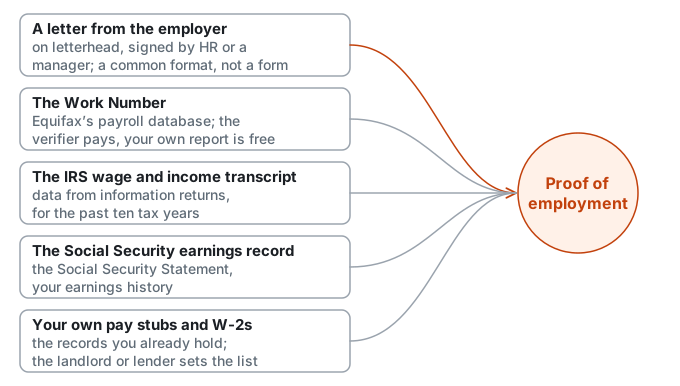
A letter. A letter is a document the employee carries to the verifier. The format people use is the employer’s letterhead, the employee’s name and job title, the start date (and end date for a former employee), full or part time, sometimes the rate of pay, signed by HR or a manager. That is a common format, not a legal requirement; the official pages cited here set no contents and name no signer. Templates are on the letter templates page.
An automated database. The Work Number’s vendor page says a person “triggers a request by signing an application, such as for a loan, lease, new job, or government assistance, which grants consent to verify income and employment”; verifiers “typically need only the applicant’s SSN,” and results are “generally instant”2. The Equifax guide says the service is free to employers and employees and verifiers pay a fee, and that each request needs a permissible purpose under the Fair Credit Reporting Act. For income requests the verifier must “certify to The Work Number that the employee’s consent was obtained – typically in the application”1. As a matter of policy the service does not provide income verifications to a third-party collection agency1.
The employee’s own copy. The service’s page says employees can “view your Employment Data Report, freeze your data, or dispute it,” and that the report shows which verifiers requested the data “in the past 24 months”2. The Consumer Financial Protection Bureau lists the company as one that “provides a free report on request” and “will freeze your consumer report if you request it”; requesting your own report does not hurt credit scores, and a dispute goes to both the company and the source of the data, which must investigate free of charge4.
Sources disagree Several different phone numbers for the service appear in the Equifax guide and on the CFPB’s company page14. The CFPB page is the official listing.
The paid-versus-free line is plain: the employee-side report is free, a verifier pays for each check14, and the official routes that cost the verifier nothing are the IRS wage and income transcript and the Social Security earnings record1213.
What a California employer must give a former employee
California does not require a verification letter in the sources cited here. It does give workers a right to their own records, which is the formal route when an employer will not write a letter8.
| Record | Deadline | Source |
|---|---|---|
| Payroll records (Labor Code 226) | No later than 21 calendar days from a written or oral request | 89 |
| Personnel records (Labor Code 1198.5) | No later than 30 calendar days after a written request | 810 |
| Signed documents (Labor Code 432) | On request; the page states no deadline | 8 |
Under section 226, current and former employees may inspect or copy their payroll records, and a violation allows $750 recoverable by the employee or the Labor Commissioner9. Under section 1198.5, the employer may charge only actual reproduction cost, must comply with one request per year from a former employee, must keep personnel records at least three years after termination, and exceptions include reference letters10. A former employee may inspect where the records are kept or receive mailed copies on paying the postage10. A payroll record is not a letter.
The mortgage rules
Fannie Mae’s Selling Guide, section B3-3.1-04 (page dated October 7, 2026), requires a verbal verification of employment for borrowers qualifying with employment income, Schedule K-1 income under 25 percent ownership or self-employment income5. For employment income the verification must be “no more than 10 business days on or before the note date,” extendable to 15 business days when the lender relies on documentation dated within 15 business days that reflects the most recent completed pay period; for K-1 and self-employment income the window is no more than 120 calendar days5. It may be completed after closing, up to loan delivery5.
The acceptable methods are “verbal, written, through an employment verification vendor, or another method the lender considers reasonable, verifiable, and appropriate,” and lenders “must identify, evaluate, and resolve any employment changes or discrepancies”5. A lender may therefore use a database in place of a call to HR5. The deeper treatment is on employment verification for a mortgage.
Sources disagree The Selling Guide section now at B3-3.1-04 was renumbered; older copies call it B3-3.1-07; the old address now returns the current section5. Pages that quote an earlier version of the guide may describe the timing or the methods differently. This page uses the current text, dated October 7, 2026.
The benefit rules
For SNAP, the federal regulation says “gross nonexempt income shall be verified for all households prior to certification.” Documentary evidence is the primary source: “Examples of documentary evidence include wage stubs, rent receipts, and utility bills,” verification “shall not be limited to any single type of document,” and the agency “must accept any reasonable documentary evidence provided by the household”6. When documents fall short, an employer is among the acceptable collateral contacts6. The household gets at least 10 days to provide verification, and processing is due within 30 calendar days of application6.
For public housing, the housing authority “must obtain and document in the family file third-party verification” of income, assets and expenses, or document why it is not available; families must sign consent forms for the release of income information7.
Landlords
No agency publishes a rule that limits what employment questions a landlord may ask. What the FTC does publish concerns tenant screening: reports on rental history, evictions, credit or criminal history are consumer reports under the Fair Credit Reporting Act, the landlord needs a permissible purpose or written permission, and a denial, a co-signer requirement, a larger deposit or a higher rent based on a report triggers an adverse action notice that names the reporting agency and explains the right to dispute and to a free report requested within 60 days11. A landlord that verifies income through The Work Number is a verifier that must have a permissible purpose and certify consent1. The documents landlords commonly accept, and a landlord-oriented letter, are on proof of employment for an apartment.
When the employer cannot or will not write it
The substitutes are records created when the employer reported pay. The IRS wage and income transcript “shows data from information returns,” is available for the past ten tax years, and leaves out state and local W-2 information12. The W-2 form itself costs $30 as part of a return copy on Form 4506 as of October 202612. The Social Security Statement “shows your current earnings record and history”13. These are covered in employment verification when the company closed.
Other pages on leaving work
Verification is one of several documents that matter when a job ends. These pages cover the rest of the cluster:
- Final paycheck law in California and final paycheck deadlines by state
- Separation documents in California
- Resignation letter and two weeks’ notice in California
- Severance agreements: the 21-day review and 7-day revocation
- What to ask HR when you are laid off
- COBRA vs Covered California
- Unemployment if you quit in California and appealing an unemployment denial
When to get help
If a California employer has not answered a written request for payroll or personnel records within the 21 and 30-day limits, the Labor Commissioner’s Office takes those complaints, and the statutes allow $750 for each violation910. A dispute about what The Work Number shows goes to the company and the source of the data first, and the CFPB’s company page is the federal listing for consumer reporting contacts4. A landlord denial based on a screening report comes with the adverse action notice that explains the dispute route11. A payroll service or an attorney can help where a records request has gone unanswered past the statutory date or a reported figure is disputed.
Frequently Asked Questions
What is an employment verification letter?
Does an employer have to give me an employment verification letter?
Not under any rule in the sources cited here. California does require an employer to make payroll records available within 21 calendar days and personnel records within 30 calendar days of a written request, which the employee can use as proof of employment8.
Who signs an employment verification letter?
The pages cited here name no required signer. The format people use is HR or a manager, and the verifier decides what it accepts.
What does an employer confirm in an employment verification?
Employer name, job title, hire date and, for a former employee, termination date; an income check adds pay, year-to-date earnings, overtime and bonus, and commissions only with consent3.
Can I see what The Work Number holds about me?
Can a mortgage lender verify my job without calling my employer?
Yes. Fannie Mae lists verbal, written, vendor and “another method the lender considers reasonable, verifiable, and appropriate”5.
What can a landlord ask about my job?
No agency publishes a limit. Tenant screening reports fall under the Fair Credit Reporting Act, and an adverse action based on one requires a notice11.
What if my employer is closed or will not respond?
Related Articles
Sources (17)
- Employment Verification Reference Guide — Equifax Workforce Solutions, 2023. Accessed 2026-10-13.
- How It Works — The Work Number (Equifax). Accessed 2026-10-13.
- Employment Verifications — Equifax Workforce Solutions. Accessed 2026-10-13.
- The Work Number — Consumer Financial Protection Bureau, list of consumer reporting companies. Accessed 2026-10-13.
- B3-3.1-04, Verbal Verification of Employment — Fannie Mae Selling Guide, October 7, 2026. Accessed 2026-10-13.
- 7 CFR 273.2, Office operations and application processing — Code of Federal Regulations, via Cornell Legal Information Institute. Accessed 2026-10-13.
- 24 CFR 960.259, Family information and verification requirements — Code of Federal Regulations, via Cornell Legal Information Institute. Accessed 2026-10-13.
- Right to inspect personnel files and payroll records: Frequently Asked Questions — California Department of Industrial Relations. Accessed 2026-10-13.
- California Labor Code section 226 — California Codes, public.law mirror. Accessed 2026-10-13.
- California Labor Code section 1198.5 — California Codes, public.law mirror. Accessed 2026-10-13.
- Using Consumer Reports: What Landlords Need to Know — Federal Trade Commission. Accessed 2026-10-13.
- Topic no. 159, How to get a wage and income transcript or copy of Form W-2 — Internal Revenue Service. Accessed 2026-10-13.
- How can I get a Social Security Statement? — Social Security Administration, December 8, 2023. Accessed 2026-10-13.
- I-9, Employment Eligibility Verification — U.S. Citizenship and Immigration Services. Accessed 2026-10-13.
- Can employers give a bad reference for a former employee? — Society for Human Resource Management, an HR trade association; cited because no federal agency page addresses the question. Accessed 2026-10-13.
- California Civil Code section 47 — California Codes, public.law mirror. Accessed 2026-10-13.
- California Labor Code section 1050 — California Codes, public.law mirror. Accessed 2026-10-13.