In brief
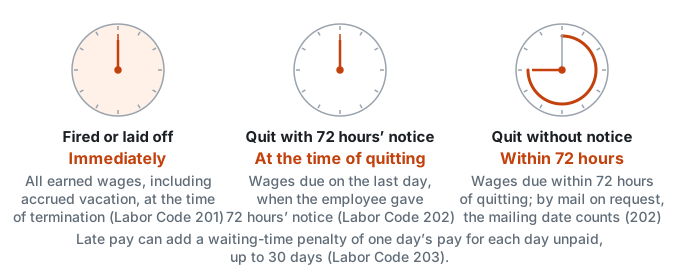
Under California law, an employee who is fired or laid off is owed all earned wages immediately, and an employee who quits without 72 hours’ notice is owed them within 72 hours. Wages paid late can carry a waiting-time penalty of one day’s pay for each day unpaid, up to 30 days.
- Fired or laid off: earned and unpaid wages are “due and payable immediately” (Labor Code section 201)1.
- Quit: wages are due within 72 hours, or at the time of quitting if the employee gave 72 hours’ notice (Labor Code section 202); the 72-hour rule covers employees without a written contract for a definite period2.
- Vested vacation is wages: a policy cannot forfeit it at termination, and it is paid at the final rate (Labor Code section 227.3)4.
- Waiting-time penalty: the daily rate of pay for each day the wages remain unpaid, to a maximum of 30 calendar days (Labor Code section 203)35.
- The official route for unpaid final wages is a wage claim with the Labor Commissioner’s Office9.
This page explains how the paperwork and process work. It is not legal, tax or HR advice, and this site is not a law firm.
The detail
When a job ends in California, the deadline for the last paycheck depends on one thing: whether the employer ended the job or the employee did. This page gives each deadline with the Labor Code section it comes from, lists what counts as final wages, and works the waiting-time penalty through with the arithmetic shown. It sits in the cluster on employment verification, explained, because the pay stub and the final check are also the first records anyone asks for after leaving. The federal baseline and other states are on final paycheck deadlines by state.
The short answer
| If you are… | The final wages are due | Source |
|---|---|---|
| Fired or laid off | Immediately, at the time of termination | Labor Code 20115 |
| Quitting with at least 72 hours’ notice and leaving on the day given | At the time of quitting | Labor Code 20225 |
| Quitting without 72 hours’ notice | Within 72 hours of quitting | Labor Code 20225 |
| Quitting without notice and asking for the pay by mail | The date the employer mails it counts as the payment date | Labor Code 2022 |
| Working under a written contract for a definite period | The 72-hour quit rule does not apply to this employee | Labor Code 2022 |
Fired or laid off: Labor Code 201
Section 201 says wages earned and unpaid at the time of discharge “are due and payable immediately.”1 The Labor Commissioner’s Office, which enforces the Labor Code through its Division of Labor Standards Enforcement (DLSE), states the same rule: a discharged employee “must be paid all of his or her wages, including accrued vacation, immediately at the time of termination.”5
The statute has one exception, for seasonal layoffs in curing, canning or drying perishable fruit, fish or vegetables, where payment counts as immediate if it is made within the reasonable time needed to compute the wages and no later than 72 hours. An employee who asks for the pay by mail and gives an address must be mailed the pay1.
Place of payment is a separate rule, Labor Code section 208: a terminated or laid-off employee is paid at the place of termination, and an employee who quits without notice and does not ask for mailing is paid at the employer’s office in the county where the work was done5.
Quitting: Labor Code 202
Section 202 sets two timings. Wages are due within 72 hours after quitting, unless the employee “has given 72 hours previous notice,” in which case they are due at the time of quitting2. The employee who quits without that notice can ask for the final pay by mail and designate an address; the mailing date counts as the payment date2. The section applies to employees without a written contract for a definite period2.
The 72 hours are the only notice period that changes a pay deadline. Nothing in section 202 requires an employee to give notice; how that fits with at-will employment, and what the law says when an employer sends a resigning employee home early, is on resignation letter and two weeks’ notice in California.
What the final pay includes
- All earned wages. The DLSE’s list for each situation is “all of his or her wages,” and for a discharge or a quit without notice it adds “including accrued vacation”5.
- Vested vacation. Labor Code section 227.3 says that where a contract or policy gives paid vacation and the employee is fired or leaves before using vested vacation, the employee “must be paid for that time” at the final rate, and a policy “shall not provide for forfeiture of vested vacation time upon termination.” A union agreement can set different terms4.
- Commissions. Earned commissions are due on the termination date for a discharge or a quit with notice, and within 72 hours for a quit without notice; commissions waiting on a condition such as a customer’s payment are due right after the condition is met5.
- Accrued sick leave: only if the employer’s policy pays it out. See the callout below.
- Severance: not required. The DLSE says there is “no legal requirement under California law that employers provide severance pay to an employee upon termination of employment.” Severance under a plan governed by the federal ERISA statute falls under federal law6. The severance rules that do apply are on severance agreements.
Sources disagree The DLSE’s Final Pay sheet, last revised in January 2011, says “there is no requirement under California law that an employer pay accrued sick leave upon termination.”6 That sheet predates California’s paid sick leave law. The Labor Commissioner’s current paid sick leave FAQ, updated December 31, 2025, says an employer is not required to pay out accrued sick leave unless the employer’s policy provides for a payout7. The two pages are consistent with each other. The newer page is the current statement of the sick leave rule; the 2011 sheet is the DLSE’s only Final Pay document and its age is the reason to read it with the newer FAQ.
On deductions, the DLSE’s paydays page says wage statements must list all deductions and that a direct-deposit authorization ends on quitting or discharge unless the employee voluntarily authorized it and the employer follows Labor Code section 213(d)5. The DLSE page does not give a complete list of lawful deductions from a final check.
The waiting-time penalty: Labor Code 203
If an employer willfully fails to pay the final wages on time, section 203 continues the wage “at the same daily rate” from the due date until the wages are paid or the worker sues, for no more than 30 days3. The DLSE describes the amount as “the employee’s daily rate of pay for each day the wages remain unpaid,” to a maximum of 30 calendar days5. Its Final Pay sheet describes the calculation as the daily wage rate multiplied by 30 days6.
Two limits in the statute: no penalty accrues for a period in which the worker hides to avoid payment, or refuses to accept a full tender of the wages plus the penalty accrued so far3. A suit for the penalty may be filed any time before the statute of limitations on the underlying wages runs out3.
The DLSE also names a defense. An employer can avoid the penalty by showing a good-faith dispute, a defense “based in law or fact” which, if successful, would preclude any recovery. Even then the employer must pay, without requiring a release, whatever wages are not in dispute (Labor Code section 206); the DLSE says a failure to do so defeats the good-faith defense6.
A worked example
Assumptions, chosen only to show the arithmetic: an employee paid $25 an hour for 8 hours a day, so the daily rate is $25 x 8 = $200. The employee is fired on a Friday and the final check is not handed over.
| Situation | Arithmetic | Penalty |
|---|---|---|
| Final wages paid 10 days after the due date | $200 x 10 days | $2,000 |
| Final wages still unpaid 30 days or more after the due date | $200 x 30 days, the maximum | $6,000 |
Those amounts come on top of the unpaid wages themselves. For a quit without notice on a Monday, the due date is 72 hours later, which is Thursday; the penalty days are counted from that due date23. The example is arithmetic from the statute’s wording, not a prediction of what the Labor Commissioner or a court would award in any case; the good-faith defense above can change the result.
Asking for the money: the official route
The Labor Commissioner’s Office takes wage claims online, by email, by mail or in person, and its claim forms and instructions can be downloaded in several languages9. The page lists limitation periods by type of claim, among them three years for minimum wage, overtime, unpaid rest or meal breaks, sick leave, illegal deductions and unpaid reimbursements, and four years for a written contract9.
A written request is not a step the Labor Code requires before a claim. The note below is a format some people use to put the request and the date in writing, not a form any law requires.
[Your name]
[Your address]
[Date]

[Employer name]
[Attention: payroll or owner]
[Employer address]

Re: Final wages for employment ending [last day of work]

My employment ended on [date] by [termination / resignation].
Under California Labor Code sections 201 and 202, my final wages
were due on [date]. As of today I have not received [the final
paycheck / the following amounts: accrued vacation of [hours] at
[rate], commissions of [amount], other: ____].

Please send the unpaid wages to the address above by [date].
Labor Code section 203 provides for continuing wages, up to 30
days, when final wages are not paid on time.

[Your name]
When to get help
The official route is a wage claim with the Labor Commissioner’s Office, filed online or on the printed forms, and the DLSE’s local offices answer questions about it9. A reason to use it follows from this page: the deadline in section 201 or 202 has passed, the amount on the check is disputed, or the waiting-time days are adding up. The deadlines for a claim differ by type of claim, so the date the wages were due matters9. Beyond the agency, an employment attorney or a legal aid organization can advise on a particular case; the publisher is not a law firm and this page is not legal advice.
Frequently Asked Questions
When must a California employer give the final paycheck if you are fired?
When must the final paycheck arrive if you quit in California?
How much is the California waiting-time penalty?
Does the employer have to pay out unused vacation?
Does the employer have to pay out unused sick leave?
Not unless the employer’s policy provides for a payout, according to the Labor Commissioner’s paid sick leave FAQ, updated December 31, 20257.
Does California require severance pay?
No. The DLSE says there is no legal requirement under California law to provide severance pay on termination6.
Where does a person file a claim for unpaid final wages?
Related Articles
Sources (9)
- California Labor Code section 201 — California Public Law (mirror of the code). Accessed 2026-10-13.
- California Labor Code section 202 — California Public Law (mirror of the code). Accessed 2026-10-13.
- California Labor Code section 203 — California Public Law (mirror of the code). Accessed 2026-10-13.
- California Labor Code section 227.3 — California Public Law (mirror of the code). Accessed 2026-10-13.
- Paydays, pay periods, and the final wages (FAQ) — California Department of Industrial Relations, Labor Commissioner’s Office. Accessed 2026-10-13.
- Final Pay (revised January 2011) — California Department of Industrial Relations, Labor Commissioner’s Office. Accessed 2026-10-13.
- California Paid Sick Leave: Frequently Asked Questions — California Department of Industrial Relations, updated December 31, 2025. Accessed 2026-10-13.
- Last Paycheck — U.S. Department of Labor. Accessed 2026-10-13.
- How to File a Wage Claim — California Department of Industrial Relations, Labor Commissioner’s Office. Accessed 2026-10-13.