In brief
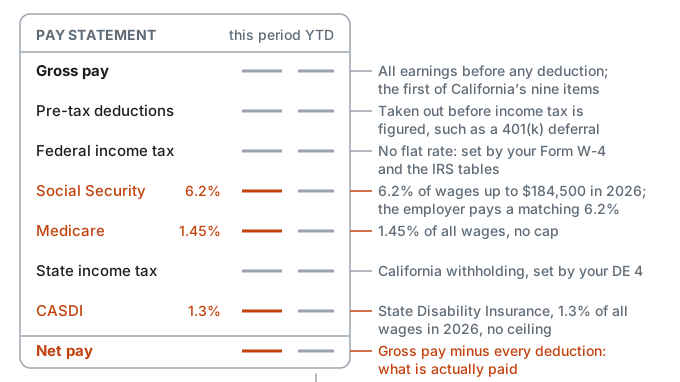
A pay stub starts at gross pay, subtracts pre-tax deductions, taxes and other deductions, and ends at net pay, the amount actually paid. For 2026 the payroll-tax lines are Social Security at 6.2 percent up to $184,500 of wages, Medicare at 1.45 percent with no cap, and, in California, State Disability Insurance (SDI) at 1.3 percent of all wages, shown on the stub as CASDI.
- Social Security is 6.2 percent of wages up to the 2026 wage base of $184,500, and Medicare is 1.45 percent of all wages; the employer pays a matching amount on top, not out of the employee’s pay12.
- Medicare adds a 0.9 percent Additional Medicare Tax on wages over $200,000 in a calendar year, withheld by the employer with no employer match1.
- California SDI is 1.3 percent of all wages for 2026, with no wage ceiling since January 1, 2024; it was 1.2 percent for 202534.
- Federal income tax withholding follows the employee’s Form W-4, and California income tax withholding follows the DE 4; neither has a flat rate35.
- California’s wage-statement law lists nine required items; year-to-date totals are not among them6.
This page explains how the paperwork and process work. It is not legal, tax or HR advice, and this site is not a law firm.
The detail
Every pay stub, which California’s Labor Code calls an “itemized wage statement,” is a short chain of subtractions. This page walks the chain in order, with the 2026 rate for each tax line, then works one example with the arithmetic shown. It sits in the same cluster as the other first-week documents in new-hire paperwork, explained, and the forms that set the withholding lines are covered in how to fill out Form W-4.
The short answer
| Line on the stub | What it is | 2026 rule |
|---|---|---|
| Gross pay | All earnings before any deduction | In California, the first required item on the statement6 |
| Pre-tax deductions | Amounts taken out before income tax is figured, such as a 401(k) deferral | Elective deferrals are excluded from W-2 Box 1 wages7 |
| Federal income tax | Withholding set by the employee’s Form W-4 | No flat rate; depends on the W-4 and the IRS tables5 |
| Social Security | Old-age, survivors and disability insurance tax | 6.2% of wages up to $184,50012 |
| Medicare | Hospital insurance tax | 1.45% of all wages; plus 0.9% on wages over $200,0001 |
| State income tax | California personal income tax withholding | Set by the employee’s DE 4; no flat rate3 |
| CASDI | California State Disability Insurance, which funds Disability Insurance and Paid Family Leave | 1.3% of all wages for 2026348 |
| Net pay | What is left after every deduction | Required item on a California statement6 |
| Year-to-date (YTD) | Running totals since January 1 | Common on stubs, not a statutory item6 |
Line by line
Gross pay
Gross pay is total earnings for the pay period before any deduction. On a California statement it is the first of nine required items, “gross wages earned”6. For an hourly employee it is hours times rate, plus overtime and any other pay; for a salaried employee it is the period’s share of the salary.
Pre-tax deductions
Some deductions come out before income tax is figured, which lowers the wages the income tax is based on. The IRS’s instructions for Forms W-2 and W-3 say Box 1 wages exclude elective deferrals, such as contributions to a 401(k)7. Whether a health premium is also pre-tax depends on the plan, and the plan’s own documents say which. Pre-tax and after-tax deductions both appear under “all deductions,” another required California item6.
Social Security and Medicare
The Internal Revenue Service (IRS) describes these as taxes under the Federal Insurance Contributions Act (FICA). For 2026 the Social Security rate is 6.2 percent for the employee and 6.2 percent for the employer, on wages up to a base of $184,500; the Medicare rate is 1.45 percent each, with no wage base limit12. Only the employee’s half is on the stub. Once year-to-date wages pass $184,500, the Social Security line stops for the rest of the year. As arithmetic, the most an employee can have withheld in 2026 is 6.2 percent x $184,500 = $11,439.00.
Medicare has a second layer. The employer withholds an Additional Medicare Tax of 0.9 percent on wages over $200,000 in a calendar year, starting with the pay period in which wages pass that amount, and there is no employer match1.
Federal and state income tax
Federal income tax withholding comes from the employee’s Form W-45. California personal income tax withholding comes from the DE 43. There is no single rate for either: the amount depends on pay, pay frequency, filing status and the entries on the form. How the forms differ is on California DE 4 vs the federal W-4.
California SDI (CASDI)
State Disability Insurance is withheld from the employee’s wages, and the Employment Development Department (EDD) notes that it appears as “CASDI” on pay stubs8. The rate is 1.3 percent for 2026, applied to all wages with no taxable wage limit or maximum withholding since January 1, 202434. The rate was 1.2 percent for 2025, 1.1 percent for 2024 and 0.9 percent for 2023, when a wage ceiling of $153,164 still applied, so a stub from an earlier year shows a different figure on this line4.
California Unemployment Insurance and the Employment Training Tax are employer-paid taxes and do not come out of the employee’s pay, so neither belongs on the deduction side of a stub3. The employer’s side is in what an employee costs a California employer.
Net pay and year-to-date
Net pay is gross pay minus every deduction, and it is the fifth of the nine items California requires6. Year-to-date columns repeat each line as a running total since January 1 and feed the Form W-2 at year end; the statute does not list them among the nine required items6.
Worked example: $20 an hour, biweekly
Assumptions: $20 an hour, 80 hours in a biweekly pay period with no overtime, no pre-tax deductions, a California employee in the tenth pay period of 2026. The federal and California income tax figures are assumed inputs for illustration, because the true amounts depend on the employee’s W-4 and DE 4 and the withholding tables; everything else is the 2026 rate applied to gross pay.
| Line | Arithmetic | This period | Year to date (10 periods) |
|---|---|---|---|
| Gross pay | $20 x 80 hours | $1,600.00 | $16,000.00 |
| Pre-tax deductions | none assumed | $0.00 | $0.00 |
| Federal income tax | assumed | $110.00 | $1,100.00 |
| Social Security | 6.2% x $1,600 | $99.20 | $992.00 |
| Medicare | 1.45% x $1,600 | $23.20 | $232.00 |
| California income tax | assumed | $38.00 | $380.00 |
| CASDI | 1.3% x $1,600 | $20.80 | $208.00 |
| Total withheld | sum of the six lines | $291.20 | $2,912.00 |
| Net pay | $1,600.00 – $291.20 | $1,308.80 | $13,088.00 |
Rates are from123. At this pay level the Social Security line would not reach the $184,500 base in 2026 (annual wages are $41,600), and the Additional Medicare Tax would not apply. The employer’s matching Social Security and Medicare do not appear in the table because they are not deducted from the employee.
Good to know The rates above are for 2026. The IRS publishes the Social Security wage base each year and the EDD sets the SDI rate each year, so a stub from another year can show a different percentage on the same line34.
Abbreviations on pay stubs
Labor Code section 226 requires the items on a California statement, not particular labels, so an employer’s payroll system chooses its own abbreviations6. These are the ones the agencies themselves use:
| Abbreviation | Meaning | Source |
|---|---|---|
| CASDI | California State Disability Insurance withholding | The EDD says SDI is “noted as CASDI on paystubs”8 |
| FICA | Federal Insurance Contributions Act taxes: Social Security and Medicare | IRS1 |
| YTD | Year to date | Not a statutory item6 |
| Net | Net wages earned | Required item6 |
| W-4 / DE 4 | The federal and California withholding forms the income tax lines follow | IRS, EDD35 |
| Box 12, code D | On the Form W-2, elective deferrals to a 401(k) | IRS7 |
A label that is not in this list, such as a plan name on a benefit deduction, is defined by the employer or the benefit plan; no agency publishes a standard list.
What California adds to the stub
Federal law does not require an employer to give a pay stub, though the Department of Labor’s recordkeeping rules require non-exempt-worker pay records9. California does: nine items, every pay period. The available paid sick leave also appears on the stub or on a separate writing given on payday10. The full checklist, the electronic-statement rule and what a missing item means are on California pay stub requirements.
When to get help
A line that cannot be explained from this page can be a benefit deduction, a garnishment or a withholding choice; the employer’s payroll or HR department can say which. The IRS and the EDD publish the rates and withholding rules for the tax lines13. If a California stub is missing a required item, or the net pay does not match the hours worked, the Labor Commissioner’s Office takes wage claims, which can be filed online, by email, mail or in person11. A tax professional or a payroll service can reconcile withholding when the W-4 or DE 4 entries are in question.
Frequently Asked Questions
How can I understand the deductions on my pay stub?
Start at gross pay and read down: pre-tax deductions, then federal income tax, Social Security, Medicare, state income tax and, in California, CASDI, ending at net pay. Social Security is 6.2 percent and Medicare 1.45 percent of wages in 2026, and CASDI is 1.3 percent13. Benefit and other deductions are labeled by the employer.
What do the codes on a pay stub mean?
What is CASDI on my California pay stub?
Why is my net pay lower than my gross pay?
Because taxes and other deductions are subtracted from gross pay: income tax withholding, Social Security, Medicare, any California SDI, and benefit contributions. Net pay is gross pay minus all of them6.
Does the Social Security line stop during the year?
Is year-to-date information required on a California pay stub?
It is not one of the nine items Labor Code section 226 lists, though many employers include it6.
Do employers have to give a pay stub?
Related Articles
Sources (11)
- Topic no. 751, Social Security and Medicare withholding rates — Internal Revenue Service. Accessed 2026-10-13.
- Publication 15 (2026), (Circular E), Employer’s Tax Guide — Internal Revenue Service. Accessed 2026-10-13.
- Rates and Withholding — California Employment Development Department. Accessed 2026-10-13.
- DE 3395 (Rev. 69, 1-26) — California Employment Development Department. Accessed 2026-10-13.
- Form W-4 (2026), Employee’s Withholding Certificate — Internal Revenue Service. Accessed 2026-10-13.
- California Labor Code section 226 — California Legislature, text on the public.law mirror. Accessed 2026-10-13.
- Instructions for Forms W-2 and W-3 — Internal Revenue Service. Accessed 2026-10-13.
- DE 2515 — California Employment Development Department. Accessed 2026-10-13.
- Fact Sheet #21: Recordkeeping Requirements under the Fair Labor Standards Act — U.S. Department of Labor, Wage and Hour Division. Accessed 2026-10-13.
- California Paid Sick Leave: Frequently Asked Questions — California Department of Industrial Relations. Accessed 2026-10-13.
- How to File a Wage Claim — California Labor Commissioner’s Office. Accessed 2026-10-13.