In brief
For 2026, the taxes a California employer pays on top of wages come to about 8.3 percent of pay for a new employer on a $20-an-hour full-time employee: $3,469 on $41,600 of wages, or $3,553 if the federal unemployment credit reduction stays at its 2025 level. Workers’ compensation insurance comes on top and has no published rate, because it is priced by industry and payroll.
- Social Security is 6.2 percent of wages up to $184,500 and Medicare 1.45 percent with no cap, each paid by the employer and matched from the employee’s pay1.
- Federal unemployment tax (FUTA) is 6.0 percent of the first $7,000 per employee, reduced to 0.6 percent by a credit of up to 5.4 percent, and paid by the employer alone23.
- California unemployment insurance (UI) is 3.4 percent of the first $7,000 for a new employer, for the first two to three years, plus 0.1 percent employment training tax (ETT) on the same base4.
- State disability insurance (SDI) is 1.3 percent of all wages in 2026 with no ceiling, but it is withheld from the employee, not paid by the employer4.
- Workers’ compensation is required from the first employee, priced by the insurer on industry classification, payroll and claims history; the state does not regulate the rate5.
This page explains how the paperwork and process work. It is not legal, tax or HR advice, and this site is not a law firm.
The detail
A wage is only the first line of what an employee costs. This page lists every payroll tax a California employer pays in 2026, with the rate, the wage base and the agency page each one comes from, then works the arithmetic for three pay levels. It also lists what is withheld from the employee (which is not an employer cost), what is required but unpriced, and what is optional. The whole sequence of hiring, from the EIN to the first payroll, is on hiring your first employee in California.
The short answer
| If you are… | Plan on this (2026, new California employer, full time, no overtime) |
|---|---|
| Paying $20 an hour ($41,600 a year) | About $3,469 in employer payroll taxes, or $3,553 with a 1.2 percent FUTA credit reduction; total cash payroll about $45,069 before insurance1234 |
| Paying the state minimum wage of $16.90 an hour ($35,152 a year) | About $2,976 in employer payroll taxes; total cash payroll about $38,128 before insurance12346 |
| Paying a $60,000 salary | About $4,877 in employer payroll taxes; total cash payroll about $64,877 before insurance1234 |
| Hiring anyone at all | A workers’ compensation policy from day one, priced by the insurer, not the state5 |
| Under 50 full-time employees | No requirement to offer health insurance, and a tax credit of up to half the premiums if you choose to and have fewer than 25 full-time-equivalent employees78 |
The figures are arithmetic from the rates below, not quotes from any agency; the rates and bases are quoted. Everything changes on January 1, and two of the inputs are set late in the year, so the “as of” dates matter.
The federal taxes an employer pays
The IRS publishes the rates in Publication 15, the Employer’s Tax Guide, in a new edition each year. For 2026, Social Security tax is 6.2 percent for the employer and 6.2 percent for the employee on wages up to $184,500; Medicare tax is 1.45 percent each, with no wage limit1. The employee also owes an Additional Medicare Tax of 0.9 percent on wages over $200,000 in a year, withheld by the employer without an employer match2.
Federal unemployment tax, FUTA, is paid “only from your own funds”; nothing is withheld from the employee for it2. The rate is 6.0 percent on the first $7,000 paid to each employee in the calendar year, and most employers receive a credit of up to 5.4 percent for the state unemployment tax they pay, which leaves a net rate of 0.6 percent, or $42 per employee3.
Sources disagree The 5.4 percent credit is reduced in a state that has carried a federal unemployment loan for two years, and the reduction is set by the Department of Labor each November9. The IRS’s draft 2026 Schedule A for Form 940 says California was “subject to credit reduction as of January 1, 2026” and that the final list and rates will not be announced until November 202610. For 2025, the Payroll Association reported the California reduction at 1.2 percent, citing the Department of Labor’s November 10, 2025 notice, which raises the net rate to 1.8 percent, or $126 per employee instead of $4211. The 2026 figure is not known as of October 2026; the extra tax is paid with the 2026 Form 940 in early 2027. Plan on the higher figure and treat the lower one as the best case.
Federal deposits must be made by electronic funds transfer. A new employer with $50,000 or less of tax in the lookback period is a monthly depositor, due by the 15th of the following month; Form 941, the quarterly return, is due the last day of the month after each quarter1. The deposit calendar is worked through on setting up payroll for a first employee.
The California taxes an employer pays
The Employment Development Department (EDD) publishes the state rates on one page. Two are employer-paid:
| California tax | Rate | Base | Who pays |
|---|---|---|---|
| Unemployment insurance (UI) | 3.4 percent for a new employer, for two to three years; after that a rate from the state schedule, 1.5 to 6.2 percent | First $7,000 per employee per calendar year | Employer |
| Employment training tax (ETT) | 0.1 percent | First $7,000 per employee per calendar year | Employer |
| State disability insurance (SDI) | 1.3 percent for 2026 | All wages; “effective January 1, 2024, all wages are subject to SDI contributions” | Employee, withheld by the employer |
| Personal income tax (PIT) | Per the employee’s DE 4 | All wages | Employee, withheld by the employer |
Source: the EDD rates page for 20264. For a new employer, UI and ETT together are 3.5 percent of the first $7,000, or $245 per employee per year. The 2025 SDI rate was 1.2 percent, so a pay stub from last year shows a different figure on that line12.
A business becomes a California employer, and must register with the EDD within 15 days, once it pays more than $100 in wages in a calendar quarter13. Returns (the DE 9 and the DE 9C) are due every quarter, filed and paid electronically through e-Services for Business, even in a quarter with no wages14. The registration steps are on registering as an employer in California.
The worked example: a $20-an-hour employee
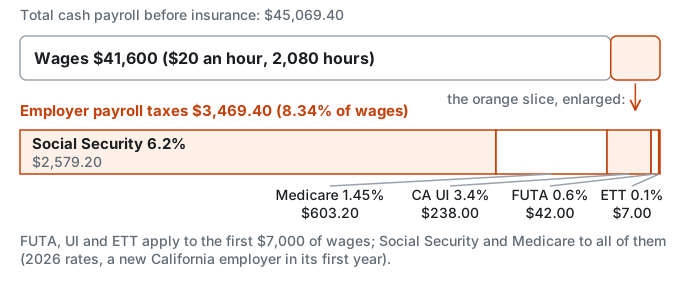
Assumptions: one full-time employee, 2,080 paid hours a year, no overtime, 2026 rates, a new California employer in its first year. Gross wages are $20 x 2,080 = $41,600. Each line is the rate above applied to its base.
| Employer cost | Arithmetic | Amount |
|---|---|---|
| Social Security | 6.2 percent x $41,6001 | $2,579.20 |
| Medicare | 1.45 percent x $41,6001 | $603.20 |
| FUTA, with the full credit | 0.6 percent x $7,0003 | $42.00 |
| California UI, new-employer rate | 3.4 percent x $7,0004 | $238.00 |
| California ETT | 0.1 percent x $7,0004 | $7.00 |
| Employer payroll taxes | $3,469.40 (8.34 percent of wages) | |
| If the FUTA credit reduction is 1.2 percent | FUTA becomes 1.8 percent x $7,000 = $126.001011 | $3,553.40 (8.54 percent) |
Total cash payroll before insurance: $41,600 + $3,469.40 = $45,069.40, or $45,153.40 at the higher FUTA rate. At the 2026 state minimum wage of $16.90, the same arithmetic gives $35,152 in wages and $2,976.12 in employer taxes6. At a $60,000 salary, $4,877.00. The percentage falls as pay rises because three of the five taxes stop at $7,000.
Withheld from the employee’s pay, and so not an employer cost: Social Security $2,579.20, Medicare $603.20, SDI at 1.3 percent, $540.804, and federal and California income tax, which depend on the employee’s Form W-4 and DE 4. What those lines look like on the stub is on how to read a pay stub.
Required, but with no published price
Workers’ compensation. Any California business with one or more employees must carry a workers’ compensation policy, bought from a licensed insurer or the State Compensation Insurance Fund, before the first employee starts515. The Division of Workers’ Compensation says the state does not regulate premium rates; the price depends on the employer’s industry classification, claims history (the experience modification), payroll and any group or dividend program, and the employer cannot charge employees any part of it5. Operating without coverage is a crime, with penalties the division’s FAQ says “can reach $100,000”5. The premium is the one line in this page’s table that only a quote can fill.
Paid sick leave. Every employee accrues at least 40 hours or five days a year, from the first day of work, usable after 90 days16. At $20 an hour, 40 hours is $800 of pay for time not worked, if all of it is used; it sits inside the 2,080 paid hours above rather than on top of them.
Payroll administration. The Small Business Administration’s own checklist puts “choose in-house or outside payroll administration” among the ten steps of setting up payroll17. Doing it yourself through the IRS and EDD portals costs nothing but time. The site earns a commission on some links to payroll and HR services, which does not affect what is described. As of October 2026 Gusto’s basic plan is $49 a month plus $6 per person, with a pay-as-you-go workers’ compensation add-on “starting at $14/mo”18; QuickBooks Payroll’s lowest bundle is listed at $44 a month plus $6.50 per employee19; Homebase’s payroll add-on is $49 a month plus $6 per employee paid, on top of a plan that starts free for one location20. None of these files anything the EDD and the IRS do not let an employer file free through e-Services for Business and electronic deposit114; what they sell is the calculation and the calendar.
Optional, and what it would cost
Health insurance is not required below 50 full-time-equivalent employees: the IRS says the employer shared responsibility provisions apply only to an “applicable large employer” that averaged at least 50 full-time employees in the prior year, and that “most employers fall below the ALE threshold”7. An employer with fewer than 25 full-time-equivalent employees and average wages under an inflation-adjusted cap that buys coverage through the SHOP Marketplace and pays at least half of employee-only premiums can claim a credit of up to 50 percent of its premium cost for two consecutive years, on Form 89418. The cap is $62,000 for the 2023 tax year on the IRS page as of October 2026; the current figure is in the Form 8941 instructions for the year.
Retirement plans are a separate rule: California’s CalSavers program requires employers with at least one employee to register or offer a plan, and that is on CalSavers for a small employer.
When to get help
The EDD’s new-employer page and the IRS’s Publication 15 answer most rate and deadline questions, and the EDD’s e-Services for Business support handles account questions free114. Two inputs on this page cannot be settled from a web page at all: the workers’ compensation premium, which only an insurer or the State Fund can quote5, and the 2026 FUTA credit reduction, which is announced in November10. A payroll service or an accountant can run the calendar for an employer who does not want to; an employer who disputes a rate assigned by the EDD has an appeal route described on the EDD’s notice.
Frequently Asked Questions
How much does a $20-an-hour employee cost an employer in California?
What percentage of wages are employer payroll taxes in California?
Does the employer pay SDI?
No. California SDI is withheld from the employee’s wages, at 1.3 percent of all wages in 2026 with no ceiling4. The employer’s state taxes are UI and ETT.
Why is California's FUTA rate higher than 0.6 percent?
Because the Department of Labor reduces the 5.4 percent FUTA credit in a state that has not repaid its federal unemployment loan; the IRS’s draft 2026 Schedule A lists California as subject to the reduction, with the rate set in November 2026910. For 2025 the reduction was reported at 1.2 percent11.
How much does workers' compensation cost for one employee?
There is no published rate. The Division of Workers’ Compensation says premiums depend on industry classification, claims history, payroll and the insurer’s programs, and that the state does not regulate them; a quote from an insurer or the State Fund is the only way to get the number5.
Do I have to offer health insurance to my first employee?
When do these rates change?
Related Articles
Sources (20)
- Publication 15 (2026), (Circular E), Employer’s Tax Guide — Internal Revenue Service. Accessed 2026-10-13.
- Understanding Employment Taxes — Internal Revenue Service. Accessed 2026-10-13.
- Instructions for Form 940 — Internal Revenue Service. Accessed 2026-10-13.
- Rates and Withholding — California Employment Development Department. Accessed 2026-10-13.
- Answers to frequently asked questions about workers’ compensation for employers — California Division of Workers’ Compensation. Accessed 2026-10-13.
- Minimum Wage: Frequently Asked Questions — California Department of Industrial Relations. Accessed 2026-10-13.
- Employer Shared Responsibility Provisions — Internal Revenue Service. Accessed 2026-10-13.
- Small Business Health Care Tax Credit and the SHOP Marketplace — Internal Revenue Service. Accessed 2026-10-13.
- FUTA Credit Reductions — U.S. Department of Labor, Employment and Training Administration. Accessed 2026-10-13.
- 2026 Schedule A (Form 940), Multi-State Employer and Credit Reduction Information (draft) — Internal Revenue Service. Accessed 2026-10-13.
- California, Virgin Islands Face FUTA Credit Reduction for 2025 — Payroll Association, November 11, 2025. Accessed 2026-10-13.
- 2025 California Employer’s Guide (DE 44) — California Employment Development Department. Accessed 2026-10-13.
- Step 1: Register as an Employer — California Employment Development Department. Accessed 2026-10-13.
- Helpful Resources for New Employers — California Employment Development Department. Accessed 2026-10-13.
- Before the First Employee Starts Work — California Department of Industrial Relations. Accessed 2026-10-13.
- California Paid Sick Leave: Frequently Asked Questions — California Department of Industrial Relations. Accessed 2026-10-13.
- Hire and manage employees — U.S. Small Business Administration. Accessed 2026-10-13.
- Gusto Pricing, Plans & Fees (2026) — Gusto. Accessed 2026-10-13.
- QuickBooks Payroll Pricing — Intuit. Accessed 2026-10-13.
- Homebase Pricing — Homebase. Accessed 2026-10-13.