In brief
After a job ends, federal COBRA lets a former employee keep the employer’s health plan by paying up to 102 percent of its total cost, with at least 60 days to elect and coverage typically up to 18 months, while Covered California accepts applications from 60 days before to 60 days after job-based coverage ends. Which one costs less depends on the plan’s premium and on household income for the year, and no source can settle that in general.
- Federal COBRA applies to plans of employers with at least 20 employees; the election window is “at least 60 days” and the premium “cannot exceed 102 percent of the plan’s total cost”1.
- Cal-COBRA covers group policies with 2 to 19 employees, caps the premium at 110 percent, and runs up to 36 months in total34.
- Covered California says you can apply “60 days before or after” job-based coverage ends, and advises applying before it ends “to avoid a gap”2.
- HealthCare.gov says voluntarily dropping COBRA “doesn’t count” as a qualifying event for the federal Marketplace5.
- For 2026 the IRS premium tax credit table ends at 400 percent of the federal poverty level, with 9.96 percent at the top6.
This page explains how the paperwork and process work. It is not legal, tax or HR advice, and this site is not a law firm.
The detail
Losing a job usually means losing employer health coverage on a date set by the plan, and two clocks start: the one on the COBRA election notice and the one on Covered California’s special enrollment window. This page sets out the deadlines, the premium rules and the points where the two programs differ, as the federal and California agencies state them. It does not say which option costs less or which to pick. The rest of the paperwork that follows a job ending is in employment verification, explained.
The short answer
| If you are… | What the sources say | Source |
|---|---|---|
| Laid off by an employer with 20 or more employees that still maintains a group health plan | Federal COBRA is available unless the termination was for gross misconduct; at least 60 days to elect; up to 102% of the plan’s total cost; typically up to 18 months | 17 |
| Covered by a group policy of an employer with 2 to 19 employees | Cal-COBRA: 60 days to elect, 45 days to make the first payment, up to 110% of the applicable rate, up to 36 months in total | 348 |
| Reaching the end of 18 months of federal COBRA | The Department of Insurance says Cal-COBRA extends coverage for people who “exhausted their 18 months on federal COBRA,” up to 36 months in total | 3 |
| Considering a Covered California plan | Apply up to 60 days before or after job-based coverage ends; apply before it ends to avoid a gap | 2 |
| Thinking of ending COBRA early | For the federal Marketplace, ending COBRA voluntarily does not open a special enrollment period; open enrollment runs November 1 to January 15 | 5 |
| Moving to a spouse’s group plan | Special enrollment must be requested within 30 days of losing eligibility for the original coverage | 7 |
Federal COBRA
The Department of Labor’s guide to COBRA says the law applies to the plans of employers that “had at least 20 employees on more than half of their typical business days in the previous calendar year”1. A qualifying event includes being laid off, quitting or retiring or having hours reduced, but not being fired for gross misconduct, and COBRA requires that the employer continue to maintain a health plan7.
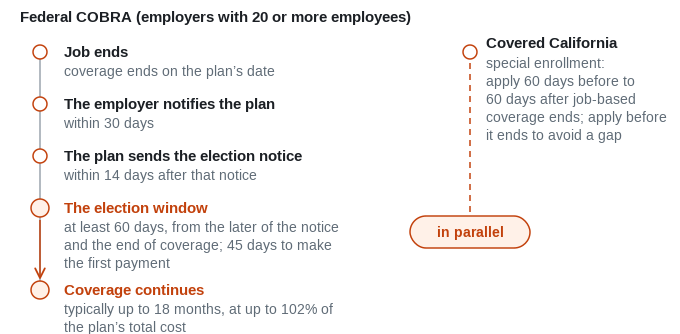
Deadlines. The employer must notify the plan within 30 days after certain qualifying events, and once the plan has that notice it must provide an election notice within 14 days1. The employee then has “at least 60 days to decide whether to enroll,” and the plan “must give you at least 45 days to make your first payment”1. The Department of Labor’s job-loss brochure says the 60 days run from the date the notice is provided or the date coverage ended, whichever is later, and that coverage begins the day the earlier coverage ended7.
Cost and length. “Your premium cannot exceed 102 percent of the plan’s total cost of providing you with coverage”1. HealthCare.gov puts it as paying “100% of the premiums, including the portion previously covered by the employer,” plus an administrative fee9. Continuation is “typically available for up to 18, 29, or 36 months,” with 18 months the usual length after a job ends1.
Cal-COBRA
California’s Department of Insurance says Cal-COBRA applies when “the group policy must be in force with 2-19 employees covered on at least 50 percent of its working days” during the preceding calendar year (or calendar quarter if the employer was not in business all year), and that the extension period “has been changed from 18 months to 36 months” for people who became eligible after January 1, 20033. The Health and Safety Code, as recorded on the public.law mirror, caps the premium at “not more than 110 percent of the applicable rate charged for a covered employee” (section 1366.26)4.
The beneficiary has 60 days after the later of the date coverage ends and the date of notice to ask for continuation in writing, and the first premium payment is due within 45 days of the written election (section 1366.24)8. The Department of Insurance FAQ does not restate those two deadlines3. The Department of Insurance FAQ does not state the employer’s own deadline for telling the insurer3.
Sources disagree Whether Cal-COBRA is for small-employer enrollees only or can follow federal COBRA depends on which source is read. Section 1366.20 states the Legislature’s intent as covering workers at employers with “2 to 19 eligible employees” who are not offered federal COBRA10. Section 1366.22(c) excludes individuals who “are covered, become covered, or are eligible for federal COBRA coverage”11. The Department of Insurance FAQ says Cal-COBRA extends coverage for people who “exhausted their 18 months on federal COBRA,” up to 36 months in total3. No single page reconciles the three. For planning, the figure to use is “up to 36 months in total,” with the Department of Insurance FAQ as the page to check against the specific plan.
Covered California and the federal Marketplace
Covered California says an applicant can apply “60 days before or after” job-based coverage ends and advises: “Apply before insurance ends to avoid a gap”2. Its page lists “COBRA coverage ended” as a qualifying event; the page does not say whether ending COBRA voluntarily qualifies, and it gives no start-date rule for job-based loss2. For loss of Medi-Cal the window is 90 days2.
For the federal Marketplace, HealthCare.gov says “When your COBRA coverage ends, you have 60 days to enroll,” “Voluntarily dropping COBRA doesn’t count,” and “Always check your coverage start date before you end COBRA”5. During open enrollment (November 1 to January 15) a person can enroll in a Marketplace plan regardless of why COBRA ended5.
The 2026 premium tax credit table
The IRS publishes an applicable percentage table each year for the premium tax credit. For tax years beginning in 2026 (Revenue Procedure 2025-25), it reads as follows6:
| Household income (percent of the federal poverty level) | Applicable percentage, 2026 |
|---|---|
| Under 133% | 2.10% |
| 133% to under 150% | 3.14% to 4.19% |
| 150% to under 200% | 4.19% to 6.60% |
| 200% to under 250% | 6.60% to 8.44% |
| 250% to under 300% | 8.44% to 9.96% |
| 300% to 400% | 9.96% |
The table stops at 400 percent. HealthCare.gov’s glossary likewise describes the credit as for people with income “between 100% and 400% of the federal poverty level”12. The revenue procedure also sets 9.96 percent as the 2026 required contribution percentage for judging whether employer coverage is affordable6. These figures are from the IRS document as issued; the current rules are on the agency pages. HealthCare.gov says savings are based on “your household size and your estimated income for the year you need coverage,” not on employment status, and built from expected income for the year of coverage rather than last year’s913.
How the two compare
| Federal COBRA | Cal-COBRA | Covered California | |
|---|---|---|---|
| Who | Plans of employers with 20+ employees1 | Group policies with 2 to 19 employees3 | Anyone who qualifies for special enrollment, including loss of job-based coverage2 |
| Election or application window | At least 60 days1 | 60 days8 | 60 days before or after coverage ends2 |
| First payment | At least 45 days to pay1 | Within 45 days of election8 | Not stated on the Covered California page2 |
| Premium | Up to 102% of plan cost1 | Up to 110% of applicable rate4 | Set by the plan chosen, reduced by any tax credit69 |
| Length | Typically up to 18 months1 | Up to 36 months in total3 | Not stated on the Covered California page2 |
| Plan | The employer’s existing plan | The existing group policy | A plan chosen from those offered |
When to get help
The first date that matters is the election deadline on the COBRA notice, because the 60-day window runs from the later of the notice date and the date coverage ended7. Questions about a COBRA notice that never arrived, or a plan’s premium, go to the plan administrator and then to the Department of Labor’s Employee Benefits Security Administration (askebsa.dol.gov, 1-866-444-3272)7. Questions about a Cal-COBRA policy go to the California Department of Insurance3. Questions about Covered California eligibility and the start date go to Covered California2. A broker or an accountant can compare a specific premium with an expected income figure; the sources here cannot.
Frequently Asked Questions
How long do I have to elect COBRA after losing my job?
How much does COBRA cost?
What is Cal-COBRA?
How long do I have to sign up for Covered California after losing job coverage?
Up to 60 days before or after the job-based coverage ends. Covered California advises applying before it ends to avoid a gap2.
Can I switch from COBRA to Covered California?
Does COBRA apply if I was fired?
Federal COBRA covers termination except for gross misconduct7.
Is Covered California cheaper than COBRA?
Related Articles
Sources (13)
- An Employee’s Guide to Health Benefits Under COBRA — U.S. Department of Labor, Employee Benefits Security Administration. Accessed 2026-10-13.
- Special Enrollment — Covered California. Accessed 2026-10-13.
- Frequently Asked Questions (health) — California Department of Insurance. Accessed 2026-10-13.
- California Health and Safety Code section 1366.26 — California Codes, via public.law (mirror). Accessed 2026-10-13.
- COBRA coverage — HealthCare.gov, Centers for Medicare & Medicaid Services. Accessed 2026-10-13.
- Revenue Procedure 2025-25 — Internal Revenue Service, applicable percentage table for tax years beginning in 2026. Accessed 2026-10-13.
- Protecting Retirement and Health Benefits After Job Loss — U.S. Department of Labor, Employee Benefits Security Administration, June 2022. Accessed 2026-10-13.
- California Health and Safety Code section 1366.24 — California Codes, via public.law (mirror). Accessed 2026-10-13.
- Health coverage options for people who are unemployed — HealthCare.gov, Centers for Medicare & Medicaid Services. Accessed 2026-10-13.
- California Health and Safety Code section 1366.20 — California Codes, via public.law (mirror). Accessed 2026-10-13.
- California Health and Safety Code section 1366.22 — California Codes, via public.law (mirror). Accessed 2026-10-13.
- Premium tax credit — HealthCare.gov, Centers for Medicare & Medicaid Services. Accessed 2026-10-13.
- Qualifying for lower costs — HealthCare.gov, Centers for Medicare & Medicaid Services. Accessed 2026-10-13.