In brief
A California employer hiring a first employee works through five stages: register (IRS employer identification number, Employment Development Department account, workers’ compensation policy, posters), post the job, complete the hire paperwork, run the first payroll, and set up the first-30-days items. The two hard deadlines after the start date are the I-9 employer section within three business days and the new-hire report (DE 34) within 20 calendar days.
- Register with the Employment Development Department (EDD) within 15 days of paying more than $100 in wages in a calendar quarter, as of October 2026; the federal employer identification number (EIN) is free from the IRS14.
- A workers’ compensation policy is required for any business with one or more employees, and the Department of Industrial Relations lists it among the things to do before the first employee starts78.
- A job posting must show the pay scale only at employers with 15 or more employees, but an applicant can ask any employer for it; the Fair Chance Act limits conviction-history questions at five or more1416.
- At hire: Form I-9, Form W-4, the DE 4, the Labor Code section 2810.5 pay notice and the EDD and workers’ compensation pamphlets; the DE 34 follows within 20 calendar days21242511.
- A new employer files federal payroll tax deposits monthly for the first calendar year, and files the EDD’s DE 9 and DE 9C returns every quarter, even in a quarter with no wages295.
This page explains how the paperwork and process work. It is not legal, tax or HR advice, and this site is not a law firm.
This page is a checklist in the order the steps happen, with the form number or rule and the agency page for each. It covers a business hiring its first W-2 employee in California; it does not cover independent contractors beyond the question of which one a worker is, which has its own page: employee or independent contractor in California. The price of the hire in payroll taxes is on what an employee costs a California employer.
Print this Each stage below is one numbered list. The “short answer” table lists the deadlines in date order. Every item names the agency page it comes from, and the Sources list at the bottom has the addresses.
The short answer
| When | What is due | Form or rule | Source |
|---|---|---|---|
| Before the first employee starts | Workers’ compensation policy in force | Labor Code section 3700 | 78 |
| Within 15 days of paying more than $100 in wages in a calendar quarter (as of October 2026) | EDD employer account | DE 1 through e-Services for Business | 47 |
| The employee’s first day of work | Employee completes Form I-9 Section 1 | Form I-9 | 21 |
| At the time of hiring | The pay notice, in writing | Labor Code section 2810.5 | 2526 |
| Within three business days of the start date | Employer completes Form I-9 Section 2 | Form I-9 | 22 |
| Within 20 calendar days of the start date | New-hire report | DE 34 | 24 |
| With the first wage payment | The signed W-4 takes effect | Form W-4 | 2 |
| The 15th of the month after each payment month (monthly depositor) | Federal payroll tax deposit | Electronic funds transfer | 29 |
| Each quarter, due January 1, April 1, July 1, October 1 | California returns | DE 9 and DE 9C | 5 |
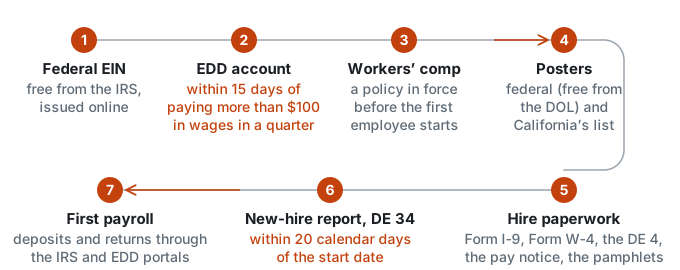
Stage 1: Register before the first day
The registrations come first because the later forms ask for the numbers they produce.
Steps
- Get the federal EIN. The online application at irs.gov is free, the IRS warns against sites that charge for an EIN, and the number is issued immediately on approval. The IRS says the application may be delayed if the entity is not yet formed with the state1.
- Check for state and local tax IDs. The Small Business Administration’s ten payroll steps include this check3. For California payroll the state ID is the EDD account in step 3.
- Register with the EDD. A business becomes a “subject employer” when it pays more than $100 in wages in a calendar quarter, as of October 2026, and must register within 15 days. Wages for that test include payment-app payments and the cash value of meals and lodging4. Registration is online through e-Services for Business and produces an eight-digit employer payroll tax account number, which goes on every deposit, return and letter5. The Department of Industrial Relations (DIR) names this registration the DE 17. The walkthrough is on registering as an employer in California.
- Buy a workers’ compensation policy. Any business with one or more employees must provide workers’ compensation under Labor Code section 3700. The policy comes from a licensed private insurer or the State Compensation Insurance Fund, and the state does not regulate premium rates8. The penalties are on registering as an employer in California, and the day-one reasoning is on workers’ compensation for a first employee.
- Put up the posters. Federal posters are free from the Department of Labor, whose Poster Advisor says which apply because “not all employers are covered by every law”10. California’s DIR list includes the Workplace Know Your Rights notice (due on or before February 1, 2026 and annually after), the wage order, the Pay Day notice, the paid sick leave notice and the workers’ compensation notice from the carrier9. The EDD supplies one notice after registration: DE 1857A, DE 1857D or DE 185811. The Civil Rights Department (CRD) says either its sexual harassment poster or its fact sheet meets the requirement12.
- Decide how each worker is classified. California presumes a worker is an employee unless the hiring entity shows all three parts of the ABC test38; the test is on employee or independent contractor in California.
Forming an LLC is separate from the steps above. The site earns a commission on some links to payroll and HR services, which does not affect what is described. LegalZoom’s formation page lists Basic at $0 plus state filing fees and Pro at $249 plus state fees, including an operating agreement and an EIN, as of October 2026; the EIN itself is free from the IRS351.
Stage 2: The posting and the interview
Steps
- Write the job description from the essential functions. The EEOC defines an essential function as “a fundamental duty of the position”; an employer never has to reallocate essential functions as an accommodation13.
- Show the pay scale if the employer has 15 or more employees. Labor Code section 432.3 requires the pay scale in any job posting at an employer with 15 or more employees, and an employer using a third party to publish the posting must give the third party the pay scale15. The DIR defines the pay scale as “a good faith estimate of the salary or hourly wage range” the employer expects to pay upon hire, and says a link or a QR code does not satisfy the rule: the pay scale must be in the posting itself14. Every employer, of any size, must provide the pay scale on reasonable request to an applicant1514. The full rule is on California pay transparency for job postings.
- Leave salary history out of the questions. An employer may not rely on an applicant’s salary history or ask for it, directly or through an agent; the DIR says nothing in the statute prohibits asking an applicant about their salary expectation1514.
- At five or more employees, leave conviction history out until a conditional offer. The Fair Chance Act (Government Code section 12952) bars conviction-history questions on the application and any inquiry before a conditional offer16. The CRD page says the law “generally prohibits employers with five or more employees” from asking before a job offer17. The denial steps are on the Fair Chance Act for applicants16.
- Avoid questions that reveal protected traits. The EEOC lists race, color, religion, sex (including pregnancy, sexual orientation and transgender status), national origin, age 40 or older, disability and genetic information, and says pre-employment inquiries that could reveal them “should generally be avoided”18. Before a job offer, “the ADA prohibits all disability-related inquiries and medical examinations, even if they are related to the job”19.
- Post the job. CalJOBS, the EDD’s job board, requires registering through e-Services for Business first; help line 1-877-622-499720.
Stage 3: The hire
The day-one items split into forms the employee completes and notices the employer provides.
Steps
- Have the employee complete Section 1 of Form I-9 no later than the first day of employment. The employee completes it; a preparer or translator may help, but the employee signs and dates21.
- Complete Section 2 within three business days of the date employment begins. The employer examines original, unexpired documents in the employee’s physical presence (remote examination is possible only for E-Verify participants), and the employee chooses which acceptable documents to present22. Keep the form for three years after hire or one year after employment ends, whichever is later; it is not mailed to USCIS23.
- Collect Form W-4. The employer gets a signed Form W-4 and makes it effective with the first wage payment; with no W-4, the employer withholds as if the employee were single2.
- Collect the DE 4. The EDD’s 2025 Employer’s Guide says “Use of the DE 4 is no longer optional” when an employee gives one; with none on file, withholding can follow the federal W-46. Both forms are compared on California DE 4 vs the federal W-4.
- File the DE 34 within 20 calendar days of the start date. As of October 2026 the penalty is $24 per employee not reported on time, or $490 for an intentional agreement not to provide or to falsify the information24.
- Give the Labor Code section 2810.5 notice at the time of hiring. It is a written notice stating pay rates, the employer’s name and addresses and the workers’ compensation carrier25. The Labor Commissioner’s FAQ says it is due no later than the start date and the agency’s template is optional26.
- Hand over the pamphlets. The EDD’s DE 2515 (disability insurance), DE 2511 (paid family leave) and DE 2320 (programs for the unemployed)11; the workers’ compensation pamphlet8; the notice of rights of victims of domestic violence, sexual assault and stalking7; and the CRD fact sheet or poster12. The agency page for each is in California new-hire paperwork.
Stage 4: The first payroll
Steps
- Pay by electronic funds transfer. Federal tax deposits must be made electronically, and the IRS lists its electronic deposit system (EFTPS) among the free methods28.
- Deposit monthly in the first year. For a new employer, a quarter before the business started counts as zero, so the employer is a monthly depositor for the first calendar year of the business: deposits for payments made in a month are due by the 15th of the next month29.
- File Form 941 each quarter. It is due by the last day of the month after the quarter ends, or the 10th day of the second month if every deposit was made in full and on time29. Federal unemployment tax (FUTA) must be deposited by the end of the month after a quarter in which it exceeds $500, as of October 202628.
- File the DE 9 and DE 9C each quarter. The returns are due January 1, April 1, July 1 and October 1, delinquent a month later (for the fourth quarter of 2026: due January 1, 2027, delinquent after February 1, 2027); they are filed and paid electronically, even in a quarter with no wages5.
- Pay on a schedule and issue a pay stub. The Labor Code 226 items and the payday rules are on California pay stub requirements. The full deposit calendar is on setting up payroll for a first employee.
Payroll can be run through the IRS and EDD portals at no charge285. As of October 2026 the vendors’ own pages list these plans. Gusto’s Simple plan is $49 a month plus $6 a month per person for basic payroll in one state, with a pay-as-you-go workers’ compensation add-on “starting at $14/mo”32. QuickBooks Payroll’s lowest bundle is $44 a month plus $6.50 per employee per month33. Homebase has a free plan for one location with up to 10 employees, and a payroll add-on at $49 a month plus $6 per employee paid34. Gusto’s page lists multi-state payroll on its Plus plan, at $80 a month plus $12 per person32.
Stage 5: The first 30 days
Steps
- Track paid sick leave from day one. An employee earns “at least one hour of paid sick leave for each 30 hours of work.” An employer may limit use to 40 hours or five days a year and total accrual to 80 hours or ten days; leave is taken after a 90-day employment period27. The rules are on California paid sick leave.
- Put the written Injury and Illness Prevention Program in place. Under Title 8 section 3203, “every employer shall establish, implement and maintain” a written program, with training for all new employees and training records kept at least one year30. See the two written plans.
- At five or more employees, schedule harassment prevention training. The CRD says employers with five or more employees must provide at least one hour of training to non-supervisory employees and two hours to supervisors, every two years, and offers a free online course31. See harassment prevention training.
- Register for CalSavers or document an exemption. See CalSavers for a small employer.
- Check which other laws attach at the new headcount. The thresholds are in one table on which employment laws apply at 1, 5, 15, 20 and 50 employees. Answering a verification request about a former employee is on how to verify a former employee.
A book beside the agency pages
The site earns a commission on some links to books, which does not affect what is described. The Employer’s Legal Handbook (Nolo), ISBN 9781413332643, is the title the research names for a first-time employer. A bookseller’s listing gives it as the 17th edition, published July 29, 2025, at a $49.99 list price, with laws for all 50 states36. The free route to the same rules is the agency page named beside each step above.
When to get help
The EDD’s new-employer page, the DIR’s “before the first employee starts” page and the IRS’s Hiring Employees page are the free official routes, and the EDD’s e-Services for Business support answers account questions572. The DIR’s Cal/OSHA Consultation service is separate from enforcement, at (415) 703-40509. A reason to ask a payroll service, an accountant or an attorney is a deadline already missed (a late DE 34 carries a $24 penalty per employee), a worker whose classification is unclear, or a gap in workers’ compensation coverage248.
Frequently Asked Questions
What paperwork is required to hire your first employee in California?
What do I need to do to hire my first employee in California?
Do I need workers' compensation for one employee in California?
Yes. The Division of Workers’ Compensation says any business with one or more employees must provide it under Labor Code section 37008.
When is the DE 34 due?
Within 20 calendar days of the start-of-work date for each newly hired or rehired employee24.
Do I have to put the pay range in a job posting?
Related Articles
Sources
- Apply for an Employer Identification Number (EIN) Online — Internal Revenue Service. Accessed 2026-10-13.
- Hiring Employees — Internal Revenue Service. Accessed 2026-10-13.
- Hire and manage employees — U.S. Small Business Administration. Accessed 2026-10-13.
- Step 1: Register as an Employer — California Employment Development Department. Accessed 2026-10-13.
- Helpful Resources for New Employers — California Employment Development Department. Accessed 2026-10-13.
- 2025 California Employer’s Guide (DE 44) — California Employment Development Department. Accessed 2026-10-13.
- Before the First Employee Starts Work — California Department of Industrial Relations, June 2017. Accessed 2026-10-13.
- Answers to frequently asked questions about workers’ compensation for employers — California Division of Workers’ Compensation. Accessed 2026-10-13.
- Required Posters — California Department of Industrial Relations. Accessed 2026-10-13.
- Workplace Posters — U.S. Department of Labor, Wage and Hour Division. Accessed 2026-10-13.
- Required Notices and Pamphlets — California Employment Development Department. Accessed 2026-10-13.
- Posters — California Civil Rights Department. Accessed 2026-10-13.
- Enforcement Guidance on Reasonable Accommodation and Undue Hardship Under the ADA — U.S. Equal Employment Opportunity Commission. Accessed 2026-10-13.
- California Equal Pay Act and Pay Transparency Law (Labor Code sections 432.3 and 1197.5): Frequently Asked Questions — California Department of Industrial Relations, page dated August 24, 2026. Accessed 2026-10-13.
- California Labor Code section 432.3 — California Codes (mirror of the Labor Code). Accessed 2026-10-13.
- California Government Code section 12952 — California Codes (mirror of the Government Code). Accessed 2026-10-13.
- Fair Chance Act — California Civil Rights Department. Accessed 2026-10-13.
- Prohibited Employment Policies/Practices — U.S. Equal Employment Opportunity Commission. Accessed 2026-10-13.
- Enforcement Guidance on Disability-Related Inquiries and Medical Examinations of Employees Under the ADA — U.S. Equal Employment Opportunity Commission. Accessed 2026-10-13.
- Register in CalJOBS — California Employment Development Department. Accessed 2026-10-13.
- 3.0 Completing Section 1, Employee Information and Attestation — U.S. Citizenship and Immigration Services, updated 04/02/2025. Accessed 2026-10-13.
- 4.0 Completing Section 2, Employer Review and Verification — U.S. Citizenship and Immigration Services. Accessed 2026-10-13.
- 10.0 Retaining Form I-9 — U.S. Citizenship and Immigration Services. Accessed 2026-10-13.
- New Hire Reporting — California Employment Development Department. Accessed 2026-10-13.
- California Labor Code section 2810.5 — California Codes (mirror of the Labor Code). Accessed 2026-10-13.
- Frequently Asked Questions: Notice to Employee (Labor Code section 2810.5) — California Department of Industrial Relations, revised March 11, 2016. Accessed 2026-10-13.
- California Paid Sick Leave: Frequently Asked Questions — California Department of Industrial Relations. Accessed 2026-10-13.
- Depositing and Reporting Employment Taxes — Internal Revenue Service. Accessed 2026-10-13.
- Publication 15 (2026), (Circular E), Employer’s Tax Guide — Internal Revenue Service. Accessed 2026-10-13.
- California Code of Regulations, Title 8, Section 3203. Injury and Illness Prevention Program — California Department of Industrial Relations. Accessed 2026-10-13.
- Civil Rights Department Reminds Employers and Employees to Complete Sexual Harassment Prevention Training — California Civil Rights Department, December 17, 2025. Accessed 2026-10-13.
- Gusto Pricing, Plans & Fees (2026) — Gusto. Accessed 2026-10-13.
- QuickBooks Payroll Pricing — Intuit. Accessed 2026-10-13.
- Homebase Pricing — Homebase. Accessed 2026-10-13.
- LegalZoom LLC formation overview — LegalZoom. Accessed 2026-10-13.
- The Employer’s Legal Handbook, 17th edition — Ripon Bookstore listing (a bookseller). Accessed 2026-10-13.
- Frequently Asked Questions: Independent Contractors — California Department of Industrial Relations. Accessed 2026-10-13.